In the modern academic landscape, a clear divide often exists between STEM (Science, Technology, Engineering, and Mathematics) disciplines and the Humanities. Technical students are frequently trained to value data, logic, and binary outcomes. However, the rigor of a university education in 2026 demands more than just technical proficiency; it requires the ability to communicate complex ideas across different domains. This is where many students encounter a significant hurdle that can impact their overall GPA.
The transition from coding or chemical equations to long-form prose is rarely seamless. For many, the challenge isn’t a lack of intelligence, but a difference in structural thinking. To bridge this gap, many high-achieving scholars seek professional essay writing help to ensure their arguments are as precise as their calculations. This type of support acts as a structural blueprint, helping students translate their analytical skills into the narrative format required by university professors worldwide. By observing how professional writers organize evidence, students learn to treat an essay like a system—with inputs, processing, and a clear output.
The Logic Gap: Analytical vs. Narrative Thinking
Technical subjects often focus on “how” things work, while history focuses on “why” things happened and what they meant. A student who can easily debug a thousand lines of code might find themselves paralyzed when asked to analyze the socio-political impact of the Industrial Revolution on urban planning. The “data” in a history class isn’t just numbers; it consists of diaries, laws, maps, and artifacts that all require a subjective lens to interpret.
The primary difference lies in the evidence. In a lab, evidence is empirical and replicable. In history, evidence is interpretive and contextual. Learning to navigate these diverse academic expectations is crucial for a well-rounded degree, but the learning curve is steep. When a student is expected to produce a 3,000-word analysis on the Cold War while simultaneously prepping for a Fluid Mechanics exam, the mental bandwidth required can reach a breaking point. This necessitates a shift in how students manage their time and resources to maintain peak performance.
Why History is a “Technical” Discipline
Contrary to popular belief, history is not just about memorizing dates. It is a data-heavy field that requires intense concentration and specific skill sets. A high-quality history paper requires:
- Primary Source Analysis: Examining original documents with a critical eye for bias.
- Historiography: Understanding how different historians have interpreted the same event over different eras.
- Contextualization: Linking local events to global shifts and economic trends.
- Synthesis: Taking thousands of pages of reading and condensing them into a singular, unique thesis.
For a student majoring in Data Analytics or Civil Engineering, these tasks require a different “operating system” for the brain. This is exactly why specialized assistance becomes a strategic necessity rather than an optional luxury. It allows the student to focus on the core concepts while seeing a professional example of how these disparate elements are woven into a cohesive academic argument.
Comparative Resource Allocation for Students
| Aspect | Technical Assignments (STEM) | History Assignments (Humanities) |
| Core Goal | Problem-solving and accuracy | Argumentation and interpretation |
| Research Base | Formulas and datasets | Archival documents and literature |
| Output Style | Reports, Code, and Proofs | Thematic and Argumentative Essays |
| Time Sink | Debugging and testing | Drafting, Bibliography, and Reading |
| Key Skill | Deductive Reasoning | Inductive and Contextual Reasoning |
Managing the Workload: A Structural Blueprint
University life is faster and more demanding than ever. Students are often balancing internships, part-time jobs, and full-time credit loads. In this environment, the “all-nighter” is no longer an effective strategy for success. Instead, successful students are turning to mentorship-based learning to streamline their output.
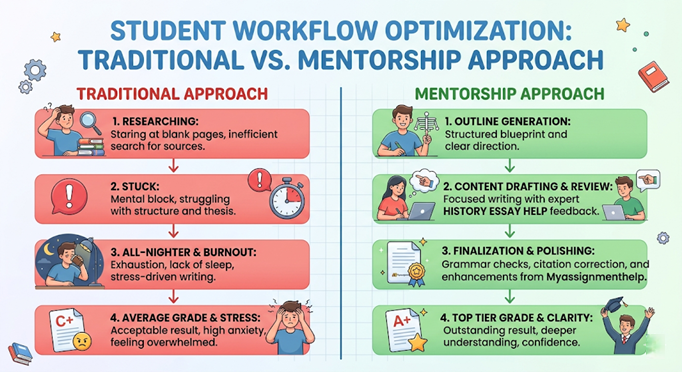
When a student struggles to find the right primary sources for a paper on the Silk Road, they don’t just need a list of books; they need to understand the methodology of historical research. By utilizing history essay help from experts at Myassignmenthelp, students can see firsthand how a professional historian structures an argument. This exposure to high-level academic writing helps students develop their own “voice” over time. Rather than struggling with the blank page for hours, the student can use the provided framework to understand how to cite sources correctly and how to transition between complex historical themes. This turns a potentially failing grade into a learning opportunity that strengthens their writing for the rest of their career.
The Role of E-E-A-T in Academic Writing
Search engines and professors alike now look for “Information Gain.” This means your work must provide unique value, not just a summary of what is already available on basic educational sites. For a technical student, achieving this in a history paper is difficult because they may lack the years of background reading required to identify “gaps” in the current historical narrative.
By collaborating with specialists, students can ensure their work meets the highest standards of Experience, Expertise, Authoritativeness, and Trustworthiness (E-E-A-T). This is especially important when dealing with controversial or complex historical periods. A well-cited paper that uses obscure primary sources will always outrank a generic summary. This doesn’t just help with immediate grades; it builds a foundation for professional communication that will serve them long after they graduate and enter the workforce, where the ability to write a persuasive memo or white paper is just as important as technical skill.
The Global Perspective on Modern Education
Whether you are studying in London, Toronto, Sydney, or New York, the expectations for academic integrity and clarity remain the same. The “global tone” of modern education emphasizes universal accessibility and clear, jargon-free communication. Professors are increasingly looking for students who can transcend their specific major to show an understanding of the world at large.
Technical students who master the art of the history essay are often the ones who rise to leadership positions in the corporate world. Why? Because they can explain the “technical” to the “non-technical” stakeholder. They can tell the story behind the data. Using academic support services to master this skill is a legitimate way to manage a heavy workload while still gaining the full benefits of a diverse education. It ensures that the student is not just a “worker,” but a “thinker” who understands the historical context of the technology they are building.
Conclusion: Investing in Your Future
The need for robust support in the humanities for technical students is not a sign of weakness, but a sign of strategic planning. By recognizing where your time is best spent and where you need expert guidance, you ensure that your academic record reflects your true potential. High-quality research, structured arguments, and professional formatting are the hallmarks of a successful student, regardless of their major. In the end, the goal of education is to learn how to learn, and sometimes the best way to learn a new skill is to work alongside those who have already mastered it.
Frequently Asked Questions (FAQ)
1. Why should a STEM student care about history essays?
Ans: History essays develop critical thinking and communication skills that are essential for leadership roles. In the tech world, the ability to explain the “why” behind a project to a non-technical audience is a high-value skill.
2. Is getting essay help considered a “shortcut”?
Ans: No. It is a form of strategic resource management. Much like using a specialized software tool for data analysis, using academic support provides a structural blueprint that helps you learn more efficiently.
3. How does history research differ from scientific research?
Ans: Scientific research is often looking for a replicable, objective result. Historical research looks for a unique perspective, a new interpretation of existing facts, or a connection between seemingly unrelated events.
4. Can these services help with specific formatting like Chicago or MHRA?
Ans: Yes. History papers often require very specific citation styles that are different from the APA or IEEE styles used in technical fields. Professional guidance ensures these technicalities are handled correctly to avoid losing marks on formatting.
5. How do I ensure my essay doesn’t look “generic”?
Ans: The key is Information Gain. By working with experts who understand deep historical context, you can include unique insights and primary source analysis that set your paper apart from standard student submissions that only use basic internet sources.
About The Author
I am Ruby Walker, a Senior Academic Consultant and Content Strategist at Myassignmenthelp, where I specialize in helping students bridge the gap between technical disciplines and the humanities. With over a decade of experience in educational mentorship, I focus on creating structural blueprints that empower students to master complex research and narrative-driven assignments.